Cobb Angle in Scoliosis: What Your Degrees Mean
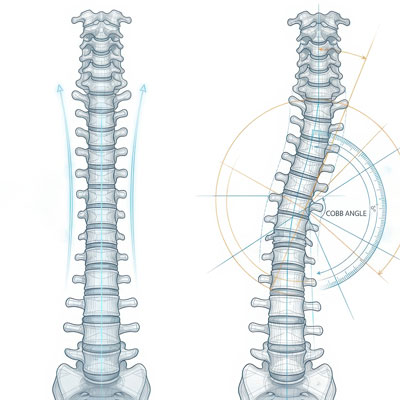
The Cobb angle in scoliosis measures how much the spine curves sideways. Doctors use this measurement on X-rays to diagnose scoliosis, assess curve severity, and monitor changes over time.
A higher Cobb angle indicates a larger spinal curve, but it does not always mean more pain or a need for surgery. Understanding this measurement can help you interpret your X-ray results and recognize when further evaluation or treatment may be needed.
What is the Cobb angle in scoliosis?
The Cobb angle is the standard method for measuring spinal curvature in scoliosis. Named after orthopedic surgeon Dr. John Robert Cobb, it measures the angle between the most tilted vertebrae at the upper and lower ends of a spinal curve.
A Cobb angle of 10 degrees or greater, along with spinal rotation, is commonly used to diagnose scoliosis.
This measurement helps doctors evaluate curve size and compare results over time. However, it does not fully describe spinal rotation or indicate how much pain a person may experience.
For example, someone with a 30° curve may have few symptoms, while another person with a smaller curve may experience muscle tension or back discomfort.
Physical changes, such as uneven shoulders, hips, or shoulder blades, can be early signs of scoliosis in children. An X-ray helps determine whether these changes are associated with structural scoliosis.
How is the Cobb angle measured?
Doctors measure the Cobb angle using a spinal X-ray, usually taken while the patient is standing. This position shows the spine’s curvature under the body’s weight.
The measurement uses the vertebrae at the upper and lower ends of the spinal curve.
Steps used to measure the Cobb angle
- Take a standing spinal X-ray: A front or back view shows the location and direction of the curve.
- Identify the end vertebrae: The doctor selects the most tilted vertebrae at the top and bottom of the curve.
- Draw reference lines: Lines are drawn along the upper surface of the top vertebra and the lower surface of the bottom vertebra.
- Measure the angle: The angle between these lines, or their perpendiculars, determines the Cobb angle.
For example, a measurement of 25° indicates a spinal curve with a Cobb angle of 25 degrees.
Digital X-ray tools can help clinicians measure spinal curves and compare results over time. However, the Cobb angle should be considered alongside posture, spinal rotation, and physical examination findings for a more complete scoliosis assessment.
What do Cobb angle degrees mean for scoliosis severity?
Cobb angle measurements help classify scoliosis based on curve size. Although classification ranges may vary, doctors commonly distinguish between mild, moderate, and larger spinal curves.
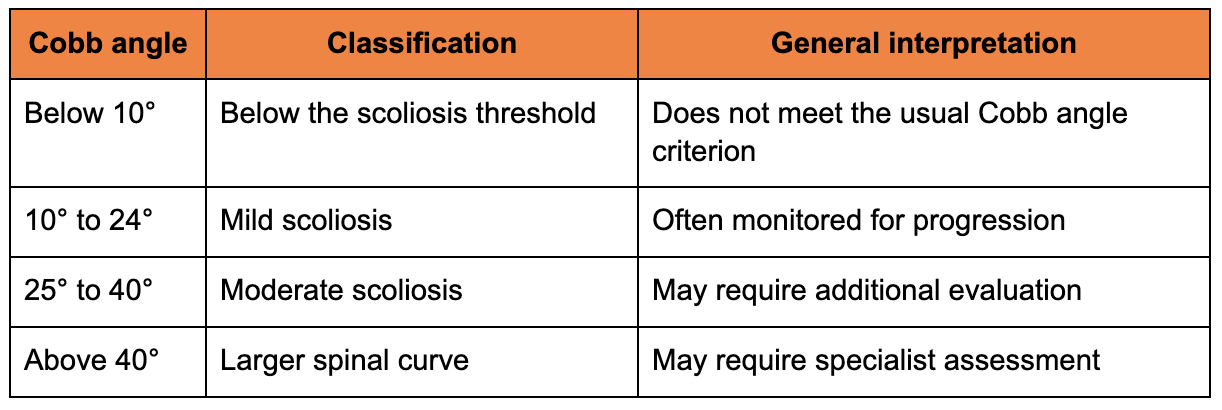
Mild scoliosis often requires observation, especially when the curve is small and stable. Children may need closer monitoring because their curves can change during growth.
Moderate scoliosis involves a more noticeable spinal curve. Treatment decisions depend on whether the patient is still growing and how likely the curve is to progress.
Larger curves need careful evaluation. Surgery may be considered for certain progressing curves, particularly when the Cobb angle reaches approximately 45° to 50° or more.
These categories are general guidelines, not automatic treatment rules. A 30° curve in a growing teenager may require a different approach than the same curve in an adult with a stable spine.
Why is the Cobb angle important for scoliosis treatment?
The Cobb angle helps doctors assess curve progression and determine appropriate treatment. Decisions also depend on age, skeletal maturity, symptoms, and curve location.
Monitoring changes in spinal curvature
Scoliosis may progress during rapid growth, especially around puberty. Children with remaining growth often need regular examinations to track changes.
Doctors compare Cobb angle measurements from previous X-rays to identify progression.
An increase of approximately 5° or more is commonly considered when assessing progression because smaller differences may result from measurement variability.
For example, a change from 20° to 27° may indicate meaningful progression, while an increase from 20° to 22° may reflect normal measurement differences.
Adults can also experience curve progression, particularly with larger curves or age related spinal changes. Understanding whether scoliosis gets worse with age helps explain why monitoring needs differ between children and adults.
Understanding treatment options
Treatment depends on curve severity, progression risk, remaining growth, and individual needs.
Common approaches include:
- Observation: Monitoring smaller or stable curves through examinations and X-rays when needed.
- Scoliosis specific exercises: Improving posture control, body awareness, and physical function.
- Scoliosis bracing: Supporting curve management and helping prevent progression in appropriate patients.
- Surgical evaluation: Assessing larger or progressing curves that may require surgery.
Bracing is commonly recommended for growing patients with curves around 25° to 40° to help prevent progression. Adults may also use specialized scoliosis braces to improve support, comfort, and daily function.
Scoliosis specific exercises and postural rehabilitation may improve movement control and physical function. These approaches can complement bracing but should not replace it when medically indicated.
For larger curves, surgical evaluation may be appropriate. However, surgery is not automatically necessary based on the Cobb angle alone.
Can the Cobb angle change over time?
Yes. The Cobb angle may increase, remain stable, or sometimes decrease depending on age, curve characteristics, and treatment.
In children and teenagers, curves may progress during growth spurts. This risk generally decreases after skeletal maturity, although some curves continue to progress in adulthood.
Larger adult curves may gradually worsen, while smaller curves can remain stable for years.
Treatment may also influence how a scoliosis curve changes. Bracing can help limit progression during growth, while some specialized bracing and scoliosis exercise programs may achieve modest curve improvements in selected patients.
Postural rehabilitation may improve movement, balance, and comfort even when the Cobb angle remains unchanged.
However, a lower Cobb angle does not always indicate permanent structural correction. Changes should be assessed across follow-up examinations rather than a single X-ray.
Why can Cobb angle measurements vary?
Cobb angle measurements may differ slightly between X-rays, even when the spinal curve has not changed.
Several factors can influence the result:
- Vertebra selection: Clinicians may choose slightly different vertebrae at the ends of the curve.
- Body positioning: Standing posture during an X-ray can affect the measurement.
- Measurement technique: Manual and digital methods may produce slightly different results.
- Spinal rotation: The Cobb angle measures sideways curvature but does not fully capture the spine’s three dimensional shape.
For example, a change from 22° to 24° may reflect measurement variation rather than actual progression.
Because scoliosis affects the spine in three dimensions, doctors also consider spinal rotation, posture, symptoms, and previous imaging when evaluating changes.
Understanding your Cobb angle and spinal health
Your Cobb angle helps explain the size of your spinal curve, but understanding scoliosis also requires looking at posture, symptoms, and how the curve changes over time.
At Haven Chiropractic Posture & Scoliosis in Asheville, NC, Dr. Alaina Gelineau uses her training in Chiropractic BioPhysics to assess spinal alignment and develop individualized care plans. Depending on each patient’s needs, care may include postural rehabilitation, corrective chiropractic techniques, or scoliosis bracing.
If you have questions about your Cobb angle or spinal health, contact us to learn more about our approach to scoliosis care.
Frequently asked questions about the Cobb angle
What is a normal Cobb angle?
A Cobb angle below 10° is generally below the diagnostic threshold for scoliosis.
Is a 20 degree Cobb angle considered severe?
No. A 20° Cobb angle is typically classified as mild scoliosis, although progression risk depends on age and remaining growth.
Can poor posture affect the Cobb angle?
Body positioning during an X-ray can affect the measurement, but everyday poor posture does not necessarily worsen structural scoliosis.
Can the Cobb angle improve without surgery?
Yes, improvement is possible in some cases. Results depend on curve severity, skeletal maturity, and the treatment used.
How often should the Cobb angle be measured?
It depends on age and progression risk. Growing children may need X-rays every four to six months, while adults with stable curves often require less frequent imaging.

Dr. Alaina Gelineau has 12 years of experience in chiropractic care. She is a specialized chiropractor, certified in Chiropractic BioPhysics, focusing on posture correction and scoliosis care in Asheville, North Carolina.