7 Early Signs of Scoliosis in Children Most Parents Miss (How to Check at Home)
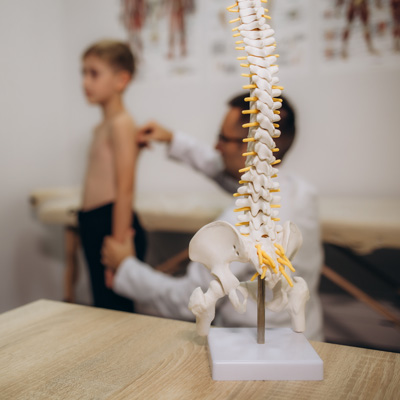
Most children with scoliosis don’t complain of pain – which is exactly why early signs of scoliosis in children are so easy to miss. The first clues are usually visual: a shirt that hangs unevenly, a shoulder that sits a little higher, a posture that looks slightly off.
Parents often notice something before any professional does. This guide helps you know what to look for, how to do a simple at-home check, and when it’s time to get a proper evaluation.
*Important: Home observation is not a diagnosis. Only a clinical examination and imaging can confirm scoliosis.
Quick Answer – What Are the Early Signs of Scoliosis?
If you’re looking for a fast reference, here are the 7 most common early indicators:
- Uneven shoulders (one sits higher than the other)
- One shoulder blade sticking out more than the other
- Uneven hips – one noticeably higher
- Uneven waistline – the waist appears asymmetrical
- Clothes that don’t hang evenly despite correct sizing
- The body appears to lean to one side when standing
- Uneven or raised areas on the back when bending forward
These signs can be subtle – especially in the early stages. They’re worth paying attention to, not dismissing.
What Is Scoliosis And Why It’s Easy to Miss
Scoliosis is an abnormal lateral (sideways) curve of the spine. In a healthy spine, the vertebrae stack in a straight vertical line when viewed from behind. In scoliosis, that line curves to one side – sometimes forming an S or C shape.
It most commonly develops during the pre-teen and adolescent growth spurts, between ages 10 and 15. And here’s what makes it so easy to overlook: in the early stages, it’s almost never painful. Children rarely say anything. The changes happen gradually and the body compensates, making them harder to spot day-to-day.
7 Early Signs of Scoliosis Parents Should Watch For
1. Uneven Shoulders
Stand behind your child while they stand naturally. Do both shoulders sit at the same height? A consistent difference – not just a casual slouch – is the most commonly noticed early sign.
2. One Shoulder Blade Sticks Out
When a spinal curve rotates the ribcage, one shoulder blade often protrudes more than the other. This is particularly visible in a fitted shirt or swimwear.
3. One Hip Appears Higher
Pelvic asymmetry is another early indicator. One hip higher than the other in a child can reflect the compensatory curve pattern that travels down from the thoracic spine.
4. Uneven Waistline
Look at the space between the arms and the torso. When scoliosis is present, the waist may appear more pronounced on one side, creating an asymmetrical silhouette.
5. Clothing Doesn’t Hang Evenly
This is a practical everyday cue many parents notice before anything else. Hemlines that ride up on one side, straps that keep slipping off one shoulder, or pants that seem uneven despite correct sizing.
6. The Body Leans to One Side
When your child stands relaxed with feet together, does their body appear to shift to one side? A consistent lean – not just a casual pose – can reflect an underlying curve.
7. Asymmetry When Bending Forward
This is the single most important visual sign to check at home. We cover how to look for it in the next section.
How to Check for Scoliosis at Home (Simple Test)
This is called the Adam’s Forward Bend Test – the same starting point used in school screenings.
Step-by-Step Instructions
- Have your child stand with feet together and knees straight
- Ask them to slowly bend forward at the waist, letting arms hang freely
- Position yourself at their eye level – behind them, looking along the spine from the tailbone upward
What to Look For
- Is one side of the back higher or more raised than the other?
- Is there a rib hump or visible bump on one side?
- Does the spine appear to curve rather than run straight?
What Is Not Normal
A visible rib hump or clear asymmetry between the left and right sides of the back is not a normal variation. It warrants professional evaluation – not alarm, but action.
When Is It Just Posture vs. Possible Scoliosis?
This is one of the most common questions parents ask and it’s an important one.
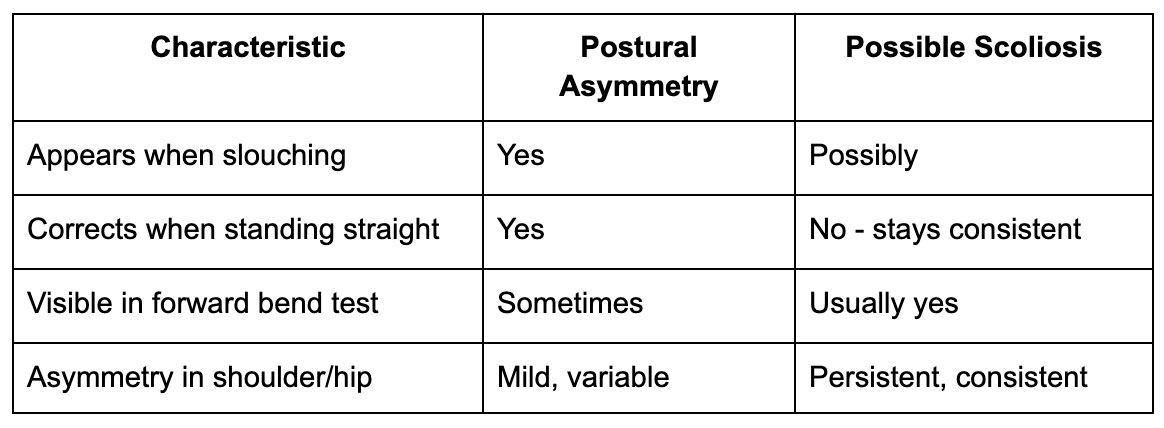
The key distinction: posture imbalances can be voluntarily corrected. Scoliotic curves cannot. They remain present regardless of how upright your child stands.
When Should Parents Be Concerned?
Seek evaluation if:
- Signs appear consistently, not just occasionally
- Asymmetry is becoming more noticeable over weeks or months
- Your child is in a growth spurt – curves can progress faster during these periods
- There is a family history of scoliosis
- Your child’s school screening flagged a concern
When to Get Your Child Checked
Make an appointment with a trained clinician if:
- Two or more signs from the list above are present
- Asymmetry is visible in the forward bend test
- You’ve noticed clothing issues or posture changes over time
- Your child is between 10–15 and entering a growth phase
Early detection is not about finding something wrong. It’s about catching a curve early enough to have the most options.
How Scoliosis Is Diagnosed
Home observation is a starting point – not a conclusion. Clinical diagnosis involves:
- Postural and physical examination – assessing shoulder, waist, and hip symmetry
- Adam’s Forward Bend Test – performed with a scoliometer to measure trunk rotation
- X-ray imaging – the only way to confirm a scoliotic curve, measure its degree (Cobb angle), and monitor progression
A Cobb angle under 10° is typically considered within normal variation. Curves above 10° are classified as scoliosis and monitored accordingly.
Why Early Detection Matters
Dr. Martha Hawes, published in the Scoliosis Journal, documented that early-stage scoliosis identified during the growth phase offers the widest range of management options – from monitoring and conservative care to bracing – before curves progress to a point where surgical options become the primary conversation.
The earlier a curve is identified, the better the long-term outlook. Waiting until a curve is obvious typically means it has already progressed significantly.
What Happens After Diagnosis
The care path depends on the Cobb angle, the child’s age, and growth stage:
- Observation and monitoring – for mild curves, scheduled X-rays track progression
- Bracing – recommended for moderate curves in growing children to prevent worsening
- Advanced corrective care – for curves requiring more than monitoring, structural approaches address spinal position during the growth window
The growth phase is both the period of highest risk and the period of greatest opportunity.
How HAVEN Evaluates Scoliosis
At HAVEN Chiropractic Posture & Scoliosis, Dr. Alaina Gelineau is the only Chiropractor in Asheville, NC certified in Chiropractic BioPhysics – a research-based, structural approach to spinal evaluation and correction.
Our scoliosis assessments include:
- Full postural and spinal analysis
- Digital X-ray imaging to measure and document the curve precisely
- A clear, honest report of findings
- A care plan focused on early-stage correction during the growth window – when intervention has the most impact
We see children, adolescents, and adults. We don’t guess – we measure.
If Something Looks Off, Trust Your Instincts
Parents often see early signs of scoliosis in children before anyone else does – in the way clothes fit, in a photo, in a casual observation at bath time. That instinct is worth acting on.
Not every asymmetry is scoliosis. But the only way to know is a proper evaluation – and the earlier a curve is found, the more we can do about it.
Schedule a scoliosis evaluation for your child – for clarity, not just reassurance.
Frequently Asked Questions
Is scoliosis painful in kids?
Usually not in the early stages. Most children with mild to moderate scoliosis feel no pain at all – which is one reason it often goes undetected until a curve has progressed.
Can posture improvement fix scoliosis?
No. General posture exercises may improve overall alignment but do not correct a structural scoliotic curve. Treating one as the other delays appropriate care.
When is bracing needed?
Bracing is typically recommended for curves between 25–40° in a growing child. It’s designed to prevent progression, not reverse an existing curve. Timing matters significantly.
How fast can scoliosis progress?
During active growth phases, some curves progress 1–2° per month. This is why monitoring requires scheduled reassessment – especially between ages 10 and 15.
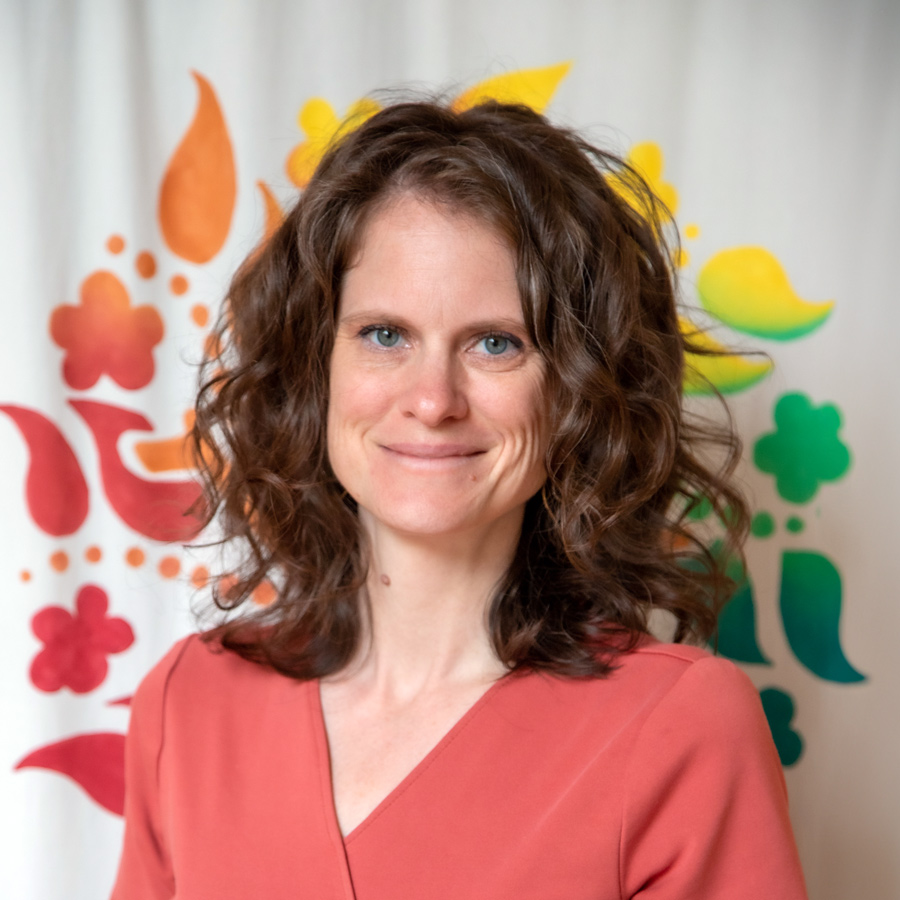
Dr. Alaina Gelineau has 12 years of experience in chiropractic care. She is a specialized chiropractor, certified in Chiropractic BioPhysics, focusing on posture correction and scoliosis care in Asheville, North Carolina.