
What Does Evidence Based Even Mean in Chiropractic Care, and How Would You Know?
If you have been looking into evidence based chiropractic care in Asheville, North Carolina, you have almost certainly read the phrase “evidence based” as part of that search. It turns up a lot now, and when any phrase turns up everywhere it starts to lose its weight. It becomes something you skim past rather than something you can actually use.
Which is a shame, because the idea underneath it is genuinely useful. Evidence based care describes something specific and worth having. Once you know what it describes, you can recognize it, ask about it, and get a sense of whether it is really happening.
Most people have never been told what the phrase refers to, or how you would gauge it. That is what this article is for, so you know what to look for.
Evidence-based is not a statement about how confident a practitioner is. It is a statement about what was measured, how, and against what.
Why is evidence based care so hard to pin down?
Part of it is that the phrase started life as a technical term. It came out of research, where it had a precise job to do, and it has since traveled a long way from there into ordinary conversation. Along the way it picked up a general sense of being careful and up to date, which is pleasant and not very informative.
So you are trying to make a real decision about your spine, and the words that sound like they should help you are the ones doing the least work. That is a frustrating place to be standing.
Here is the part worth knowing. Evidence based is checkable, and you already know how to check it. You do a version of it every time you have blood work done.
How do you measure whether something is actually working?
Think about how the rest of your healthcare handles this.
Blood pressure has a healthy range. So do cholesterol, blood sugar, thyroid levels, and bone density. Those ranges are not anyone’s preference. They were established by measuring large numbers of people over long stretches of time and observing what tends to happen at different values. That is what makes a range a standard rather than an opinion.
So the sequence is familiar, even if you have never thought of it as a sequence. Something gets measured. The number is compared to the range. If it sits outside that range, it becomes the thing worth working on. Something changes, and then the same measurement is taken again to find out whether the number moved back toward where it belongs.
Notice what is doing the work there. Not how anyone felt about the plan, and not how confident anyone was that it would help. The number moved or it did not, and you can see it as clearly as anyone else in the room.
Progress is defined as movement back toward a known normal, and it is confirmed by measuring the same thing again.
The spine has this too, and it is the part most people have never been told. There is a defined normal for how the spine is aligned, and alignment can be measured against it. That is what turns a spinal x-ray into a measurement rather than a picture, and it is why the same measurement can be taken again later and compared to the first one.
That normal was not simply declared. It was worked out and published. Harrison, Janik, Troyanovich and Holland compared the curvatures of actual cervical spines against a theoretical ideal model of the neck viewed from the side, in the journal Spine, in 1996. Spine is a mainstream indexed journal rather than a chiropractic one, so the model was put in front of a readership with no particular reason to be generous to it.
A standard you can look up is a standard you can hold someone to. That is true of a cholesterol range and it is true of spinal alignment.
This is also where evidence based care earns its keep, and why it is worth understanding rather than skimming. A standard does not only tell you where one person stands today. It is what makes it possible to ask a much bigger question: does this approach actually move people back toward normal, across many people, over a long time? That question has an answer built out of numbers.
A recommendation tells you what someone believes is a good idea, and that can be genuinely valuable. It is a different thing from a measurement. Evidence based is the version where the numbers exist, the reasoning is visible, and you are not being asked to take anyone’s word for it, ours included.
What does evidence based actually refer to?
Take that same logic and scale it up from one person to a whole approach, and you have arrived at what the phrase means. Evidence based refers to the study behind a claim, and the standard that study was held to.
Four things about any study are plain facts rather than matters of opinion, and all four are checkable by anyone.
- How it was designed. Was there a comparison group, and were people assigned to groups at random? Random assignment is what keeps the results from reflecting who happened to be chosen for which group.
- How many people it followed. A finding in eight people and a finding in eighty are different kinds of finding.
- How long it followed them. This one is treated as a detail and it is not a detail. More on it below.
- Where it was published, and whether it was peer reviewed.
Peer review, in plain terms: before a journal publishes a study, it sends the paper to other researchers in the same field who had nothing to do with the work. They read the methods, look for problems, and can require changes or recommend that the journal decline it. Peer review is not a guarantee that a finding is correct. It means people with the training to object had the chance to object.
Where a study is published matters for a related reason. When work on a chiropractic method appears in a general rehabilitation or medical journal, it has been held to that journal’s standard rather than only to the standards of its own field.
These are facts about a paper, not opinions about a practice. You are allowed to ask about them, and most patients have never been told there is anything to ask.
Measured, not assumed
Here is the distinction the whole phrase rests on.
Measured, not assumed is the difference between believing something changed and being able to show it. It requires an objective standard that sits outside anyone’s opinion, and it requires that the same measurement be taken before care, during care, and again afterward. Then change is demonstrated rather than trusted.
Without that, progress is an impression. Impressions move with how the week went, with how well you slept, with hope, and with the ordinary fact that everyone involved wants it to be working. That applies to the practitioner as much as to the patient, which is exactly why the standard has to sit outside both of them.
That is the whole distinction. When the measurement is there, someone can tell you whether something changed. When it is not, what you have is a belief about whether it changed. A belief can be sincere, well informed, and offered in complete good faith, and it is still a different kind of statement than a measurement. Knowing which one you are being given is the thing worth being able to do.
The idea has two halves, and they belong together. The first is did it change, which is answered by measuring at the start and measuring again. The second is did it hold, which is answered long after care has ended. The second half is harder, more expensive, and far more often skipped.
What actually gets measured at a visit, and why is there so much of it?
This is where the idea stops being academic, because the same standard that applies to a study applies to one person in an exam room.
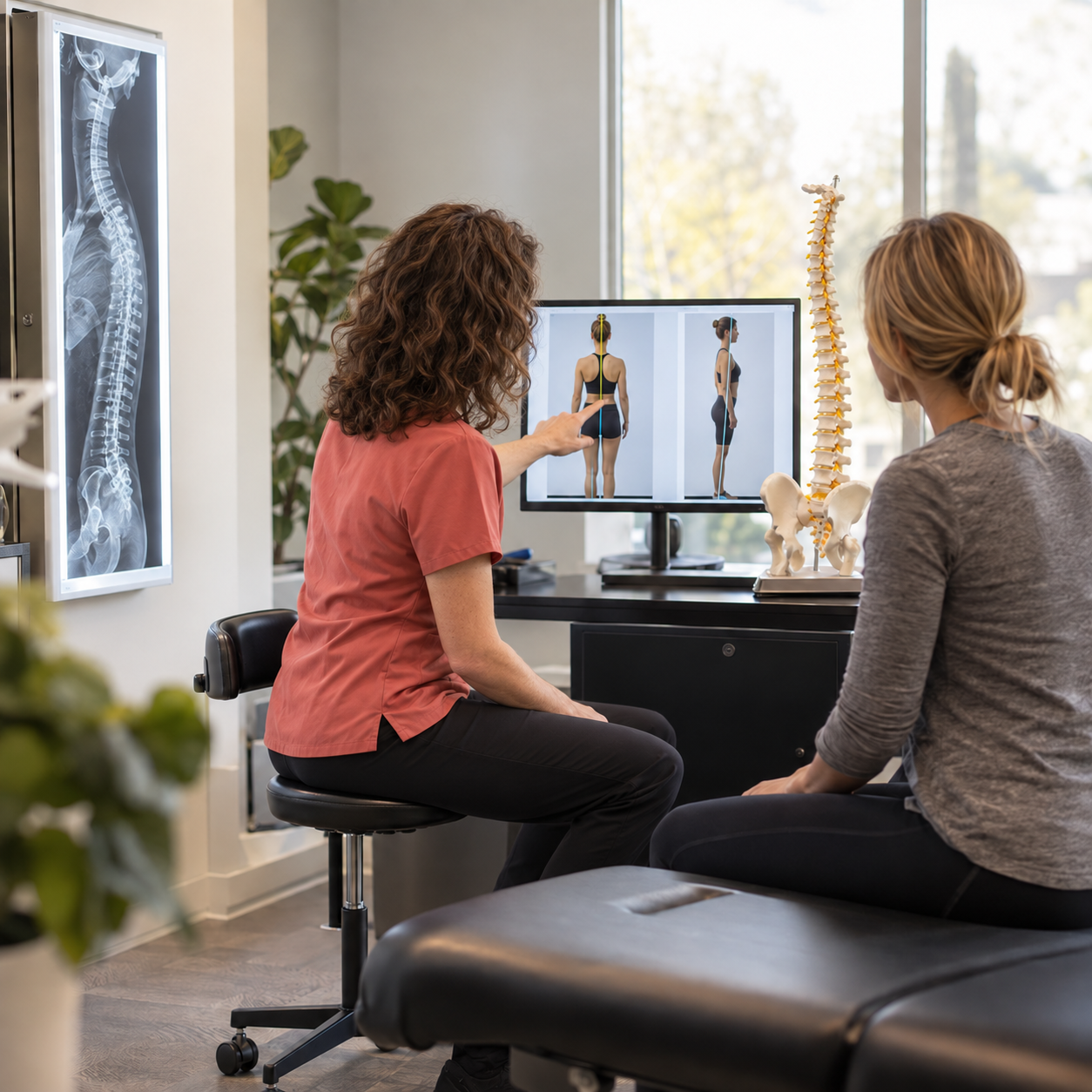
At HAVEN, an evaluation includes digital range of motion, digital posture screens, x-ray evaluation, and outcome assessments. None of those are done once. They are repeated, because a baseline only counts if something gets compared to it later.
Patients tell us it feels like a lot of measuring. It is a lot of measuring, and that is the point.
The alternative is asking how you feel and treating the answer as data. How you feel matters enormously. It is the reason to do any of this. It is also the least stable instrument in the room, which is why it belongs in the goal rather than in the measurement. Feeling better on a Tuesday and feeling worse on a Thursday tells you about Tuesday and Thursday. It does not tell you whether the structure of your spine changed.
The reason a research team goes back and measures patients a year later is the same reason this practice re-images and re-measures rather than relying on impressions. One standard, applied to a study and applied to a person.
Why is long term follow up the harder question?
Almost anything looks effective at six weeks. Short term relief is easy to produce and easy to measure, which is why short term outcomes are the norm in the field. Coming back a year or two later is expensive, it is often the first thing cut from a study with limited funding, and it is the only thing that answers the question a patient is actually deciding about. Nobody is deciding whether to feel better for a month.
A follow up period is simply how long after treatment ended the researchers went back and measured again. Two examples from the Chiropractic BioPhysics research base, both of which put the question of duration in the title of the paper rather than burying it.
Two year follow up, published 2022.
Moustafa, Diab and Harrison published a randomized trial in the Journal of Clinical Medicine testing whether rehabilitating the curve of the neck improved nerve root function and pain in cervical spondylotic radiculopathy, which is a nerve root problem in the neck. The follow up period is named in the title of the paper: two years. The researchers came back two years later and measured the same things again. Whatever the study found, it is a claim about two years rather than about six weeks, and that is checkable by anyone who looks up the paper.
Short and long term outcomes, published 2016.
Moustafa, Diab, Taha and Harrison published a randomized trial in Archives of Physical Medicine and Rehabilitation on adding a sagittal cervical posture corrective orthotic device to a multimodal rehabilitation program for discogenic cervical radiculopathy. Two things are worth noticing. The researchers named short and long term outcomes in the title, which is the distinction in this article stated by the people who ran the study. And Archives of Physical Medicine and Rehabilitation is a mainstream indexed rehabilitation journal rather than a chiropractic one, so the work was held to the standard of a field outside its own.
A note on how far that claim goes. A number of the randomized trials in this body of work state a follow up period of one to two years in the title, the 2022 trial above among them. That is a real body of evidence at a time when short term outcomes are the norm in the field. It is a description of those trials and not a claim about the profession, and the difference between those two statements is the subject of this article.
One more limit, and it matters here more than anywhere. Describing the quality of a body of research is not a prediction about any individual. A well designed study with long follow up tells you something about how a method was tested. It does not tell you what will happen in your neck.
Do not take our word for it.
If you are deciding whether a practitioner is actually evidence based, these are the questions worth asking. They work on any provider, including us.
Question 1: “How will you know if this is working?”
A useful answer names something objective and repeatable, something that can be measured the same way twice. Feeling better is the goal, not the measurement.
Question 2: “What are you measuring before we start, and when will you measure it again?”
A baseline only counts if something gets compared to it later. The second measurement is the one that matters, so ask when it happens.
Question 3: “Is there research behind this approach, and where was it published?”
Look for a real answer with journal names in it. “Studies show” is a phrase anyone can say.
Question 4: “How long did those studies follow patients?”
Almost anything looks effective at six weeks. Ask whether anyone checked a year or two later, because that is a much harder study to run and a much more useful one.
Question 5: “What would tell you this is not working?”
Anyone who is measuring can answer this. It is a fair question and a revealing one, and it is the question almost nobody asks.
Question 6: “Has your approach changed in the last few years, and why?”
A method that never changes is not a method that has been proven. It is one that has not been tested.
Ask us these. We would rather be asked.
Why does the care here keep changing?
Question six deserves its own answer, because the honest one is easy to misread.
Measurement produces revisions. When a protocol is measured against a standard, some of what it produces will be better than expected and some will not, and the ones that are not get changed. Instrumentation gets re-evaluated on the same terms. The Impulse adjusting instrument is one example of a tool in this field that has continued to be studied and developed rather than being settled once and left alone.
So the care offered here this year is not identical to the care offered two years ago, and it should not be. What can look from the outside like restlessness, new equipment and updated protocols and a plan that is not what it was, is what a method being tested against a standard looks like from close up.
What this means for you:
You are not being asked to trust a claim. You are being shown a measurement, and then shown it again later so the two can be compared.
A comprehensive posture and spinal evaluation establishes what is actually there: how your spine is structured, how it is managing load, and what will be re-measured later so that change can be shown rather than assumed. Whether corrective care is warranted, and what kind, is what the evaluation exists to answer.
And you are entitled to ask anyone for the same standard, including us.
Because pain is a signal.
Posture is the foundation.
And alignment changes outcomes.
Strong Posture. Optimal Function. Lasting Wellness.
Frequently asked questions
What does evidence based chiropractic actually mean?
It refers to the research behind a method and the standard that research was held to, including how studies were designed, how many people they followed, how long they followed them, and where they were published. It is a description of measurement, not a description of how confident a practitioner is.
How can I tell if a chiropractor is evidence based?
Ask what will be measured, when it will be measured again, where the supporting research was published, and how long those studies followed patients. Those are questions with concrete answers, and the answers give you something you can actually weigh.
What does peer reviewed mean in plain language?
Before publishing, a journal sends a study to other researchers in the field who did not do the work. They examine the methods and can require changes or recommend rejection. It does not guarantee a finding is correct. It means qualified people had the opportunity to object.
Is there a normal range for spinal alignment, the way there is for blood pressure?
Yes. Spinal alignment has defined normal values that measurements are compared against, which is what allows a change to be shown rather than assumed. It is the same logic as a lab range, applied to structure instead of blood chemistry.
Why would a chiropractor take x-rays more than once?
Because a single image is a baseline and nothing more. Comparing a later image to it is what shows whether the structure of the spine actually changed, rather than relying on how someone felt that week.
Why does long term follow up matter in research?
Short term relief is common and relatively easy to produce, so results at six weeks say little about durability. Studies that measure again a year or two after treatment ended answer a different and more useful question.

Dr. Alaina Gelineau has 12 years of experience in chiropractic care. She is a specialized chiropractor, certified in Chiropractic BioPhysics, focusing on posture correction and scoliosis care in Asheville, North Carolina.